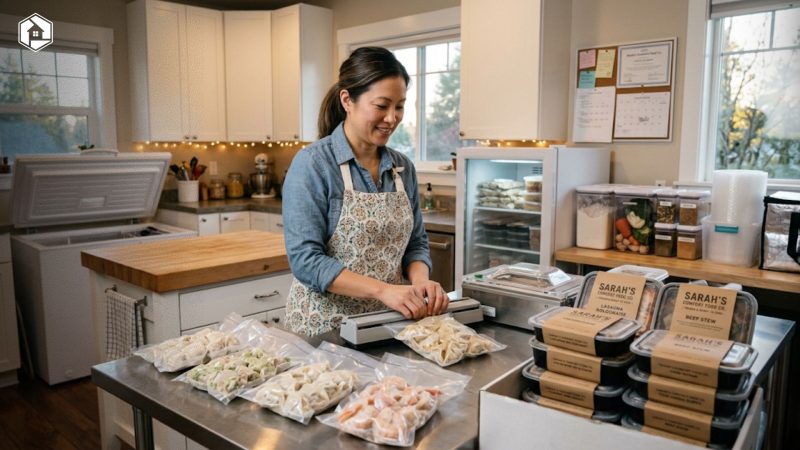
IDEBIZ — A homemade frozen food business can help you turn your cooking skills into a source of income without renting a commercial kitchen from day one. To get started, choose a product with clear market demand, calculate your production costs, set a profitable selling price, and maintain proper food safety standards. Idebiz.id encourages aspiring entrepreneurs to build a business around practical planning, consistent product quality, and sustainable profit.
Want to calculate your potential earnings before investing? Start by listing your ingredients, packaging, labor, electricity, delivery expenses, and expected selling price. These numbers will help you understand how much capital you need and whether your products can generate a healthy profit.
Why a Homemade Frozen Food Business Can Be a Practical Opportunity
Frozen food offers convenience for busy households, working professionals, students, and small food businesses. Customers can store products in their freezers and prepare them whenever they need a quick meal or snack.
For entrepreneurs, this model offers several practical advantages. You can start with a small production batch, sell through social media or messaging apps, and increase production as orders grow.
Moreover, you can develop different products for different customer groups. For example, families may prefer frozen chicken nuggets and dumplings, while office workers may look for ready-to-cook meals. Small cafés and food stalls may also purchase frozen snacks in larger quantities.
However, convenience alone does not guarantee profitability. You still need to manage ingredient costs, freezer capacity, product quality, packaging, and delivery. Therefore, treat your homemade frozen food business as a real business from the beginning rather than simply selling extra portions from your kitchen.
How to Start a Homemade Frozen Food Business from Scratch
1. Choose Products That Match Your Target Market
First, identify a specific customer group before deciding what to sell. This approach helps you develop products that solve real customer problems instead of producing items without a clear market.
For example, you could explore these product categories:
-
-
Frozen snacks: spring rolls, dumplings, risoles, and potato croquettes.
-
Ready-to-cook meals: marinated chicken, seasoned beef, and prepared cooking ingredients.
-
Family favorites: meatballs, chicken nuggets, and homemade sausages.
-
Traditional foods: frozen pempek, pastel, and other regional specialties.
-
Premium products: high-quality dumplings, specialty fillings, or convenient meal kits.
-
Next, evaluate your competitors. Check their prices, packaging sizes, customer reviews, product variations, and delivery options. You can also interview potential customers to learn which products they buy regularly and what they dislike about existing options.
After that, select one or two products for your initial launch. A focused menu makes it easier to control inventory, maintain consistent quality, and calculate production costs.
2. Calculate Your Startup Capital
Before purchasing equipment or ingredients, create a realistic startup budget. You do not need to buy every piece of equipment immediately, especially when your existing kitchen can support small-scale production.
Your initial budget may include:
|
Startup expense |
Example budget |
|---|---|
|
Initial ingredients |
Rp500,000 |
|
Food-grade packaging and labels |
Rp250,000 |
|
Kitchen utensils and small equipment |
Rp400,000 |
|
Initial marketing and product photos |
Rp150,000 |
|
Food safety and sanitation supplies |
Rp200,000 |
|
Total estimated startup capital |
Rp1,500,000 |
These figures represent an illustrative budget, not a fixed market price. Actual costs will depend on your location, equipment, product selection, and existing kitchen facilities.
In addition, keep some cash available for repeat ingredient purchases, unexpected expenses, and delivery costs. This working capital helps you continue production while waiting for customers to pay.
3. Prepare Your Kitchen and Food Safety Process
Food safety should shape your business operations from the beginning. Frozen products still require careful handling because freezing does not automatically eliminate every harmful microorganism.
-
- Start by separating raw ingredients from ready-to-eat foods. Clean and sanitize food-contact surfaces, use appropriate storage containers, and follow safe cooking, cooling, and freezing procedures.
- Next, establish a consistent production process. Record ingredient quantities, preparation times, batch dates, and storage conditions. These records help you maintain product consistency and investigate quality problems.
- Pay particular attention to your freezer. Monitor its temperature, prevent unnecessary temperature fluctuations, and follow appropriate food safety guidance for the specific product you manufacture. Do not assume that every frozen product has the same shelf life.
You should also check the applicable Indonesian requirements for your product category, including business registration, food production authorization, labeling, and halal certification where relevant. Requirements can differ between product types and production models, so verify the rules before selling at scale.
4. Test Your Products Before Launching
Once you select your initial products, produce a small test batch and ask potential customers to evaluate it.
Focus on taste, texture, portion size, packaging, convenience, and price. In addition, test how the product performs after freezing, storage, and preparation according to your intended instructions.
For example, a spring roll may taste delicious immediately after cooking but become soggy after freezing and reheating. You need to identify these problems before investing in large quantities.
Use customer feedback to refine your recipe and packaging. Then, calculate the cost of the revised product so that improvements do not unexpectedly eliminate your profit.
How to Calculate Homemade Frozen Food Business Profit Margins
A successful homemade frozen food business needs more than strong sales. You must understand the difference between revenue, production costs, gross profit, and net profit.
1. Calculate the Cost of Goods Sold
Start by calculating the cost of producing one batch. Include every expense directly associated with manufacturing your products.
Your calculation should cover:
-
-
Ingredients and seasonings.
-
Food-grade packaging, labels, and seals.
-
Direct production labor.
-
Production-related utilities where practical.
-
Other costs directly associated with manufacturing.
-
Suppose you produce 50 packs of frozen dumplings. Your estimated production costs look like this:
|
Production expense |
Cost |
|---|---|
|
Ingredients and seasonings |
Rp250,000 |
|
Packaging and labels |
Rp50,000 |
|
Direct labor |
Rp75,000 |
|
Production utilities |
Rp25,000 |
|
Total production cost |
Rp400,000 |
To calculate the production cost per pack, divide the total production cost by the number of packs produced.
Cost per pack = Total production cost ÷ Number of packs
Rp400,000 ÷ 50 = Rp8,000 per pack
This means each pack costs Rp8,000 to produce under these assumptions. However, this figure does not yet include every operating expense, such as marketing, payment fees, delivery subsidies, or general business administration.
2. Set a Profitable Selling Price
After calculating the production cost, choose a selling price that covers your expenses and provides an acceptable return.
A common mistake is to add a small amount to the ingredient cost without considering packaging, labor, utilities, or other expenses. This approach can make a product appear profitable while the business actually loses money.
Instead, calculate your target price using your desired gross margin.
Selling price = Cost per pack ÷ (1 − Target gross margin)
For example, if your production cost equals Rp8,000 and your target gross margin equals 40%:
Rp8,000 ÷ (1 − 0.40) = Rp13,333
You could test a selling price of Rp13,500 per pack, provided the market accepts that price and your other expenses still allow a reasonable net profit.
Remember that a 40% gross margin does not mean you keep 40% of the selling price as net profit. You still need to deduct operating expenses.
3. Calculate Your Profit Margin
Profit margin measures how much profit you retain from each rupiah of sales.
Use these formulas:
Gross profit = Sales revenue − Cost of goods sold
Gross profit margin = (Gross profit ÷ Sales revenue) × 100%
Net profit = Sales revenue − Total business expenses
Net profit margin = (Net profit ÷ Sales revenue) × 100%
Gross profit helps you evaluate production efficiency and pricing. Meanwhile, net profit gives you a more complete picture of your business performance because it includes operating expenses.
For accurate calculations, use consistent accounting periods and avoid counting the same expense twice. If you already include production labor in your product cost, for example, do not deduct that same labor expense again when calculating net profit.
Example of a Homemade Frozen Food Business Profit Calculation
Let’s apply these formulas to a small business selling frozen dumplings. Assume you produce and sell 200 packs in one month at Rp15,000 per pack. Your production cost remains Rp8,000 per pack.
| Financial item | Calculation | Amount |
|---|---|---|
| Monthly sales revenue | 200 × Rp15,000 | Rp3,000,000 |
| Production cost | 200 × Rp8,000 | Rp1,600,000 |
| Gross profit | Rp3,000,000 − Rp1,600,000 | Rp1,400,000 |
| Other operating expenses | Marketing, administration, and delivery subsidies | Rp400,000 |
| Estimated net profit | Rp1,400,000 − Rp400,000 | Rp1,000,000 |
Your gross profit margin would equal:
Rp1,400,000 ÷ Rp3,000,000 × 100% = 46.67%
Your estimated net profit margin would equal:
Rp1,000,000 ÷ Rp3,000,000 × 100% = 33.33%
These results illustrate how a homemade frozen food business might perform under the stated assumptions. They do not guarantee actual earnings. Your real results will depend on demand, product waste, discounts, sales volume, equipment costs, taxes, and other expenses.
Also, check whether your monthly operating expenses adequately account for equipment depreciation, freezer maintenance, unsold inventory, and your own management time. Including these costs will give you a more realistic picture of profitability.
Marketing Strategies to Increase Frozen Food Sales
Once your product and pricing make sense, focus on attracting customers and encouraging repeat purchases.
1. Use Social Media to Show the Product
Instagram, TikTok, and WhatsApp can help you introduce your products to potential customers. Instead of posting only promotional graphics, share useful content that demonstrates the product’s value.
For example, create short videos showing preparation methods, serving suggestions, packaging processes, and practical meal ideas. Use clear product photos and display important details such as pack size, ingredients, storage instructions, and ordering information.
However, avoid making unsupported claims about health benefits or shelf life. Build trust through accurate product information and consistent quality.
2. Offer Trial Packs and Bundles
New customers may hesitate to purchase a large quantity from an unfamiliar brand. Therefore, introduce a reasonably priced trial pack that lets them evaluate your product.
You can also create bundles for families or customers who want several menu options. Before offering discounts, calculate the total cost of each bundle to ensure that the promotion still generates an acceptable contribution toward your operating expenses.
3. Build Repeat Orders
Repeat customers can help you plan production more efficiently. Encourage them to provide feedback, remind them about available products, and share new menu options when relevant.
In addition, record your weekly sales by product. This information helps you identify bestsellers, reduce slow-moving inventory, and decide which products deserve more marketing attention.
For local customers, consider partnerships with small cafés, food stalls, catering businesses, or neighborhood resellers. Nevertheless, calculate wholesale prices separately because bulk discounts can reduce your profit per pack.
Common Mistakes to Avoid When Starting a Frozen Food Business
Even a promising product can struggle when the owner overlooks basic business management.
- First, avoid setting prices based only on ingredient costs. Include packaging, labor, production utilities, and other relevant expenses before deciding how much to charge.
- Second, do not produce too much inventory before confirming demand. Start with manageable batches, collect customer feedback, and increase production as sales become more predictable.
- Third, avoid neglecting food safety. Incorrect handling, poor temperature control, or unsuitable packaging can damage product quality and customer trust.
- Finally, do not confuse cash received with profit earned. You may receive payments from customers while still facing unpaid supplier bills, unsold inventory, or equipment expenses. Track your cash flow alongside your profit and loss so that you can make better decisions.
Frequently Asked Questions
1. How much capital do I need to start a homemade frozen food business?
You can start with a relatively small budget if you already have suitable kitchen equipment and a freezer. For example, an illustrative starting budget of Rp1,500,000 may cover initial ingredients, packaging, basic utensils, sanitation supplies, and marketing. However, calculate your actual requirements before investing because equipment purchases and regulatory needs can increase your startup costs.
2. What is a good profit margin for a homemade frozen food business?
There is no single profit margin that suits every frozen food business. Your target depends on production costs, competitor pricing, customer demand, distribution expenses, and your business model. Calculate both gross and net profit margins, then evaluate whether the remaining profit adequately compensates you for your time, capital, and business risks.
3. How can I calculate the selling price of homemade frozen food?
First, calculate your total production cost and divide it by the number of packs produced. Next, divide the unit cost by one minus your target gross margin. For example, a production cost of Rp8,000 per pack and a target gross margin of 40% produce a calculated selling price of approximately Rp13,333. Finally, compare that price with customer expectations and account for other operating expenses before finalizing your price.
Starting a homemade frozen food business becomes more manageable when you understand your target customers, develop a consistent product, maintain food safety, and calculate your profit margins accurately. You do not need to launch a large operation immediately. Instead, start with a focused product range, test your market, monitor your costs, and improve your business decisions as you collect real sales data.
However, knowing how to make a product is only one part of entrepreneurship. You also need practical skills in business planning, financial management, pricing, marketing, and customer development.
Idebiz.id can help aspiring entrepreneurs develop these skills through practical business training. If you want to turn your homemade frozen food idea into a more structured and sustainable business, explore training that helps you plan your business model, manage costs, identify market opportunities, and develop an effective sales strategy.
📞 Contact Idebiz to Register for Business Training
-
📲 WhatsApp Admin: 0813 805 8460
-
🌐 Official Website: www.idebiz.id
-
📸 Instagram: @Idebiz_id
Start with a clear plan, understand your numbers, and build your business one step at a time.