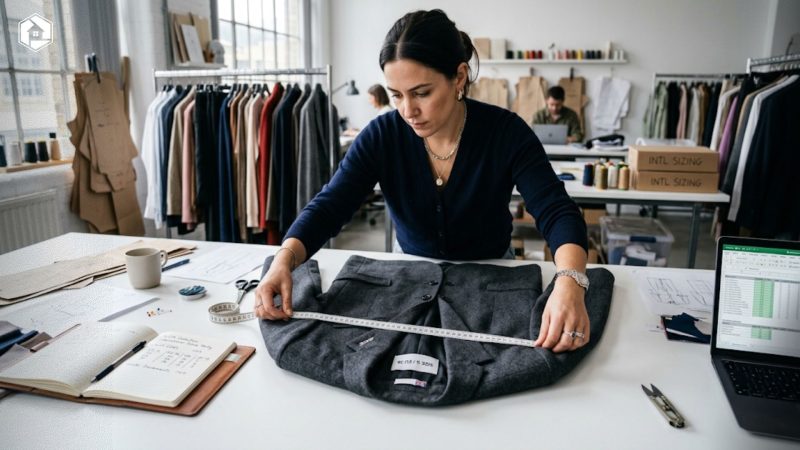
IDEBIZ — High return rates silently kill international fashion brands. Furthermore, when you sell apparel across borders, standard sizing labels like “M” or “L” mean vastly different things in different countries. For instance, a Medium top that factories produce for Asian markets often feels like an Extra Small to a US buyer and fits awkwardly on a German customer.
To succeed in Western markets, you must build an international apparel sizing strategy around precise body measurements, standardized technical packs (Tech Packs), and localized size translations. First, US buyers generally expect generous, comfortable cuts based on imperial measurements (inches). Meanwhile, European shoppers prefer tailored, contour-aligned fits measured in centimeters. Consequently, experts at Idebiz.id show that aligning your garment specifications directly with regional body measurements drastically reduces international product returns and protects your profit margins.
Therefore, if you want to scale your fashion exports to American and European markets, you must avoid relying on basic size conversions. Instead, you need a dedicated international apparel sizing strategy that aligns your product design with regional buyer expectations.
       [ US Market ]                  [ EU Market ]
 🔲 Imperial System (Inches)    📏 Metric System (Centimeters)
 🔲 Generous, Relaxed Fit       ✂️ Tailored, Contour Fit
 🔲 Larger Shoulder & Hip Room  📐 Precision Tolerance Limits
Why Cross-Border Sizing Differences Make or Break Your Apparel Brand
First of all, Western shoppers demand consistency. In fact, poor fit causes over 40% of all e-commerce fashion returns in Western markets. As a result, high return rates destroy profit margins through double shipping costs, restocking fees, and unsellable open-box inventory.
However, when you master fit precision, you instantly boost customer satisfaction, increase repeat purchases, and protect your margins. Ultimately, optimizing your fit creates a strong competitive advantage in saturated markets.
Decoding the Metric vs. Imperial Gap: US vs. EU Sizing Standards
To build better apparel, understanding body shape expectations matters just as much as converting numbers between metric and imperial systems.
Key Differences Between US, UK, and European Fit Preferences
-
US Market: This market relies on imperial units (inches). In addition, American buyers generally favor relaxed cuts with extra ease around the chest, waist, and hips.
-
EU Market (Continental Europe): On the other hand, this market uses metric units (centimeters). Thus, European buyers expect structured, form-fitting silhouettes with narrower waist cuts and higher armholes.
-
UK Market: Meanwhile, the UK uses metric-derived numerical sizing (UK 8, 10, 12), which sits neatly between US ease and Continental European structure.
4 Proven Steps to Build an Effective International Apparel Sizing Strategy
Step 1: Create Standardized Tech Packs with Clear Tolerance Limits
First, never send factories simple artwork files. Instead, always supply detailed Tech Packs that contain exact garment flat measurements, stretch percentages, and strict grading rules. Furthermore, set rigid tolerance limits (such as a maximum +/- 0.5 inches or 1 cm deviation) so mass production matches your original spec sheet perfectly.
Step 2: Implement Multi-Region Size Charts with Body Measurements
Next, display actual body dimensions on your product pages rather than listing just garment dimensions. In addition, include clear visual diagrams that guide customers on where to place the measuring tape on their chest, waist, and hips.
Step 3: Use 3D Digital Sampling to Validate Fit Across Body Types
Furthermore, modern 3D fashion design software allows you to test digital patterns on realistic 3D avatars. Because these avatars match average US and EU body profiles, this step helps you spot fit problems long before you cut physical fabric.
Step 4: Run Real-World Fit Testing with Regional Focus Groups
Finally, test physical prototypes on live fit models who match your target demographic in height, frame, and proportions. After all, a garment that looks fine on a mannequin can easily bind around shoulders or pull at seams on a real person.
Real-World Scenario: How Fit Standardization Cut Return Rates by 35%
Recently, a local activewear brand exported seamless leggings to US and German buyers using a single generic sizing table. Consequently, return rates surged to 28% in the first quarter because US customers found the waistbands tight, while German buyers reported excess length at the ankles.
┌──────────────────────────────────────────────────────────┐
│              BEFORE FIT OPTIMIZATION                     │
│  Single Generic Size Table ➔ 28% Return Rate             │
└──────────────────────────┬───────────────────────────────┘
                           │
                           ▼
┌──────────────────────────────────────────────────────────┐
│              AFTER FIT OPTIMIZATION                      │
│  - US: Adjusted rise + relaxed hip room                  │
│  - EU: Adjusted inseam length                            │
│  - Added detailed body measurement charts               │
│  RESULT ➔ Return Rate dropped to 11% (35% reduction)     │
└──────────────────────────┴───────────────────────────────┘
To solve this issue, the brand revised its international apparel sizing strategy by separating pattern development into two distinct regional cuts. Specifically, they relaxed hip dimensions for the US market and adjusted inseam lengths for European buyers. As a direct result, this targeted adjustment cut overall return rates down to 11% within five months and boosted positive customer reviews significantly.
Frequently Asked Questions (FAQ)
Q1: How do I convert garment sizes accurately between the US and Europe?
A1: You should avoid using simple general conversion tables. Instead, always convert precise body measurements (bust, waist, hips, and inseam) directly from inches to centimeters (1 inch = 2.54 cm) while adjusting for regional ease expectations.
Q2: What is the main cause of sizing discrepancies in exported clothing?
A2: Usually, discrepancies stem from missing technical specifications in Tech Packs, uncontrolled fabric shrinkage during washing, and failing to account for regional body shape differences between Asian manufacturing standards and Western buyers.
Q3: How many fit samples should I create before starting mass production?
A3: You need to produce at least two fit sample rounds (Proto Sample and Pre-Production Sample). Then, test these samples thoroughly on live fit models who represent your target market’s average measurements.
Expanding your fashion brand into the US and European markets offers massive profit potential, but sizing mismatches and fit inconsistencies can ruin your international reputation. Therefore, if you want to master international production standards, create pinpoint Tech Packs, and eliminate costly return rates, Idebiz.id provides expert-led training and hands-on mentorship tailored to your export goals.
📞 Contact Idebiz to Register for Training:
📲 WhatsApp Admin: 0813 805 8460
🌐 Official Website: www.idebiz.id
📸 Instagram: @Idebiz_id